I Watch Movies Sometimes: 2010 Foreign Edition

2011 March 12

A few weeks back, leading up to the Oscars, I attempted to watch a movie a night. Once I watched Dogtooth on early in the week, I decided to just run with it and watch more movies not made in America.

Dogtooth

Like most movies, I think this one could have benefitted from me not being half-asleep through most of it. The word every single person uses to describe Dogtooth is “disturbing”. I think the cover displaying a girl with a bleeding mouth and missing tooth warn you of what you’re getting into. That said, I’m pretty sure I was totally out during the most unnerving scene in the movie. I woke up and there was a dead animal on the ground and the characters standing around it. I don’t think that’s all that spoilery, but maybe my indifference towards the film affects my judgment when it comes to revealing plot points.

The entire film revolves around a dysfunctional family where the children are obviously not normal. As the film unfolds, you realize they’ve been totally secluded from the outside world, and taught all sorts of strange and incorrect things by their batshit parents. But I could never get invested in the concept at all. Sure, it’s a commentary on how control and isolation can wreak havoc on impressionable and powerless subjects, but the concept is so totally out there and weird that it never clicked with me. And it didn’t stick with me, either. Most parents that control their children as much as possible usually do it for what they think is their benefit. What’s the benefit of the licking other people’s bodies? Not sure why that stands out to me now, but jesus if that wasn’t the most irrationally strange thing ever. Maybe I missed something while I was too busy falling asleep and someone can explain it to me?

Basically nothing clicked at all here. There are parts that are clearly meant to be darkly amusing, but the only thing that elicited a smile was one of the girls reenacting Rocky. Oh, and I guess a vagina being called a keyboard was funny enough. But I’ve already undermined my thoughts by saying how I wanted to snooze 15 minutes after starting it up on Netflix Instant Watch (and ultimately succeeded). I didn’t know Greek people got this weird, I thought they just liked having corrupt governments.

Enter The Void

I almost made it through this movie without falling asleep. I may have even only half-dozed off. In this case, it has less to do with the content of the movie than the length. My God, is this shit incomprehensibly long. The first half of the movie is pretty damn great, as the first-person perspective and the dreaminess that comes along with it creates shots that remain in your mind. And there’s one scene repeated throughout the movie that definitely won’t exit my mind for a long while. I remember being maybe two-thirds through the movie and thinking that scene was done with and it came back and almost gave me a heart attack and I wanted to curse Gaspar Noe. I haven’t seen Irreversible, but I know some people had a similar reaction to that entire film.

Anyway, the second half is where it drags on forever, with the camera swinging back and forth across Tokyo, giving me a goddamn headache, showing the lives of the residents connected to the main character. Like in Boardwalk Empire, Paz De La Huerta is naked seemingly most of the time she’s on screen (it’s to distract people from her face), and she’s still a terrible actress — as is the main character. I’m not sure if it was a conscious choice on Noe’s part to have the protagonist — who you see almost exclusively from behind — speak with absolutely no inflection at all. It’s totally disconcerting and frustrating. I would consider the possibility that Noe wanted the viewer to insert himself into the role as much as possible, but then he would have stuck with the first-person perspective instead of pulling the camera back behind the dude’s head. He definitely wanted the sensation of the protagonist watching his own life — a life where he spoke in a monotone voice, apparently.

So while I was sucked in by the first half of the movie, with its bright flashing Tokyo lights seen from the perspective of a drug-dealing and -taking kid, the second half eventually lost its appeal somewhere around minute 130. Yes, there’s a point to the length that’s pointed out earlier in the film, but it still didn’t make it any less unbearable. Yet, I’d still recommend it. And if I could see it in a proper theater tomorrow, I’d be all over it. I’d probably feel the need to take some sort of drugs beforehand, but either way, it’s the type of movie that lends itself to a big screen. Unlike Dogtooth, which did not move me at all, there’s something here that sticks with you — whether it’s the spectacular credits, or the eerie feeling of being a ghost drifting through the world, or the thought of re-living your life in the same manner portrayed in the film.  It’s a ride that goes on for too long, but it’s a ride nonetheless.

The credits sequence is a necessary YouTube embed, but it’s nothing like watching it on your HDTV in pitch black, which is nothing like watching it in a movie theater:

httpvh://www.youtube.com/watch?v=dL0lNGXoP8E

Animal Kingdom

Hey, a more traditional movie! Like Enter the Void, this one is also in English, but instead of from France, this comes from Australia. A crime film that centers around the youngest member of the crime family and his place in the world after his mother passes away to start the film. Guy Pierce, who is fucking awesome and underappreciated, plays the role that introduces the idea of natural selection and the food chain. Somehow this is handled without being cheesy, as Pierce comes across as a cop trying to both intimidate and reason with the teenage protagonist stuck in the middle of a terrifying and crumbling mess of a family.

There’s quite a few twists in the film, and even more moments where my heart was in my throat either from shock at what had just taken place on screen, or from a achingly tense scene. There’s one shot in particular where you know something is going to happen — and then it doesn’t. The movie is filled with encounters that turn out completely unlike how you would expect, and it’s for the better in almost every instance.

I feel like it takes the movie a while to kick into gear, but the last 45 minutes on the whole are close to flawless. It also took me pretty much until the very last scene for me to warm up to the main character. He seemed like a deaf and dumb teenage with a sullen look on his face most of the time; I guess that can happen when your mom dies. It’s very different from the lead performance in another foreign crime film released in the past couple of years, A Prophet, which is probably a superior film.

The Secret in Their Eyes

I haven’t seen many Spanish-speaking movies, but something about this one just felt Hispanic as hell.  The way love is handled and the flirting and the drinking — I can just see the world of this film reflected in my Puerto Rican mother. To be specific, this is an Argentinian film, and it’s also the odd man out here, as it was released in 2009.

It’s strange; I enjoyed this movie quite a bit, but I can’t find too much to say about it. I will admit it’s interesting how the movie works as two mysteries 25 years apart, one a murder case, and one  just a lingering sense of doubt. In an amusing coincidence, I was talking with a middle-aged female co-worker who said how she liked “epic” movies that took place over a long period of time, and also mysteries. It was like she described this film. I just remembered the soccer stadium scene that adds to the perceived scope of the film — and also the Hispanic-ness.

The ending does feel immensely clichéd, even though the events that lead up to it are very affecting. But it’s also an ending I’m sure this co-worker would eat up. Yeah, I’m spent talking about movies, I think. I don’t know how Roger Ebert does it.

NeoGAF 2010 Movies of the Year (and Mine)

2011 March 2

Back in the beginning of 2008, I made an official voting thread over at the forum known as GAF for their collective 2007 movies of the year. Informally, it was already NeoGAF, but now it’s totally trademarked and everything. But then around the same time the following year, I was banned. The 2008 thread –and then the 2009 thread for whatever reason — was handled by other forum members. I guess it took Inception for me to reinstate myself.

Here are the 2010 results (complete with movie posters!), which are visible for non-members. For those of you who would rather not click, here’s the top 20 in list form. Think of these as the Nerd Oscars.

1. Inception
2. The Social Network
3. Black Swan
4. Toy Story 3
5. Scott Pilgrim vs. The World
6. True Grit
7. The King’s Speech
8. Kick-Ass
9. How to Train Your Dragon
10. The Town
———————————————————————————————–
11. Exit Through the Gift Shop
12. Shutter Island
13. Winter’s Bone
14. 127 Hours
15. The Ghost Writer
16. The Fighter
17. Dogtooth
18. Animal Kingdom
19. Blue Valentine
20. Enter the Void

There are probably plenty of critics who have top tens that are very similar to the bottom ten above. It was a really good year for film.

My personal list:

1. Blue Valentine
2. The Social Network
3. Inception
4. The Ghost Writer
5. Animal Kingdom
6. Scott Pilgrim vs. The World
7. Shutter Island
8. The Town
9. Black Swan
10. Enter the Void

Some really quick random thoughts:

- Blue Valentine just devastated me so much that I couldn’t imagine selecting any other movie as #1, not even Inception.

- I believe I’ve already commented on here on the slickness of The Social Network; this blog post goes into extreme film buff detail about the incredible directing job by David Fincher.

- The Ghost Writer is just a really well-constructed old-school thriller made by a rapist.

- Animal Kingdom is a massively under-the-radar Australian crime film — a slow burner that only gets better as it unravels, concluding in the most satisfying way possible.

- I enjoyed Scott Pilgrim, alright? I appreciate Edgar Wright’s comic and stylistic sensibilities. -

- Shutter Island would have been amazing in black-and-white, but that cinematography made the colorful dream sequences stand out that much more.

- The Town cemented Ben Affleck as a damn good director (what?). Meanwhile, Darren Aronofsky put together a bit of a hot mess in Black Swan — the guy sure has style, though.

- Enter the Void is painfully overlong, but it sticks in your head for even longer, which is why it deserved a spot on the list.

- In case you were wondering, I saw Exit Through the Gift Shop and I didn’t love it. Jackass 3D is above it in the documentary category.

- Movies that I want to see but haven’t yet: True Grit, Toy Story 3, The King’s Speech, Winter’s Bone, 127 Hours, The Fighter.

I’m going to write a bit more about some recently watched movies (including some mentioned here) sometime this week.

What I’ve Been Up To

2011 February 28

I know I have fans who have been wondering where the updates have been in 2011. It’s two full months into a new year and I haven’t written about my favorite stuff from 2010, or New Years’, or spring training, or Carmelo, or the Islanders game I went to, or video games, or music. Don’t worry, my WordPress installation did not have a Y2K11 breakdown — I’ve just been busy with Roto Hardball, fretting over the opposite sex, analyzing my internet anonymity, and watching too much stuff on my still-awesome HDTV. When I need a quick break from all that, Wank.io is my go-to for a bit of lighthearted fun online.

The last time I posted, Cliff Lee had just become a Phillie. Maybe it’s just taken me this long to recover from that blow. Luckily, the Mets are pretty much in a reassessing mode, so over this year of Phillies dominance they can work on building towards 2012, especially with all the money coming off the books. I just look forward to seeing a healthy lineup of Reyes, Pagan, Wright, Beltran, Bay, and Ike for 2011. But enough about the Mets, as I can save that for another post.

While I’ve spent plenty of time putting together link posts for Roto Hardball, it’s not that blog’s fault that I haven’t written a blog post here in a while. Whenever I’ve felt like writing about something else other than fantasy baseball, it’s been a fairly personal topic that I thought was better suited to my hipster-worthy Moleskine notebook. I tried to work out problems and issues on the page, writing them out with a pen instead of typing them out with a keyboard — as if that would make a difference. Maybe I’m just preparing for the inevitable appointment with a shrink; instead of talking, I’ll be able to just give the doc my journal.

It’s funny when you worry about things blowing up in one way, and then having them blow up in a way you never thought would happen. On a related note, part of growing up is being able to deal with something not turning out the way you hoped. It’s also important to know when to stop giving, even if you think it’ll make you feel better. In the end, it only adds to a massive feeling of resentment. This reminds me of Blue Valentine — which you should watch as soon as it hits Netflix Instant. The independent movies are always on there much quicker than the big guns.

I’d go into Oscars discussion now, but, 1) I didn’t watch the ceremony, and, 2) I haven’t seen 7 out of 10 Best Picture nominees. I have no idea how to punctuate that sentence. I am listening to the winner of Best Original Score as I write this, though. I thought the Inception soundtrack was fantastically bombastic, but the work Trent Reznor and Atticus Ross did for The Social Network is just so damn cool and much more conducive to writing. I’d listen to the Inception soundtrack while skydiving.

But yeah, the past two months. I’ve been meaning to look for a new job for the past month and a half or so. That hasn’t happened. The nearest equivalent would be applying to the MLB Dream Job of sitting in a room for seven months and watching every single baseball game of the 2011 season, while blogging and making videos about my experience. But one of the application questions asked if I was of legal drinking age, so I hope it involves imbibing alcohol as well.

By far the coolest thing that’s happened to me recently was attending a bloodbath between the Islanders and Penguins. A friend called me up the day of, and I said I’d be down for going to my first Islanders game this century. Like most of America, I no longer follow hockey, but I knew that the last game between the two teams had resulted in a broken face for Islander goalie Rick DiPietro. So I was expecting for fights. But I didn’t think the Islanders would a 4-0 lead into the first intermission, while also participating in a couple of one-on-one fights which only served as precursors to a full-out brawl. By the end of the game, the Islanders had scored 9 times.

While I complained earlier in this post about when things don’t work out as planned, this Islanders game was perfect. Each team only had a handful of players left on their benches by the end of the game due to the insane amount of game misconducts. In the final minutes, fights were breaking out after every face-off and chants of “We want ten!” were reverberating throughout the stadium. And I got to witness a mother yell out, “THIS IS WHAT WE’RE RAISING!” after she heard some vulgar taunting in the parking lot. It was a wonderful night, topped off by watching the highlights at the Hooters nearby; it was not until seeing the fighting condensed into a few minutes that my friend and I truly appreciated what we had just experienced.

If I felt more comfortable sharing my life details on here (a.k.a. GIRLS), I assure you this post would be longer and much more entertaining. I try to make up the difference with GIFs.

Cliff Lee is New York Public Enemy #1

2010 December 14

What am I supposed to write here? I just want to type a string of expletives. I want to post stupid GIFs to display my range of emotions. I just spent the entire evening following Twitter like a massive baseball nerd, enjoying myself way too much reading fake Cliff Lee tweets and jokes about Chase Utley’s wife. I never quite believed the Phillies rumors, so I was able to keep a smile on my face, knowing there was no way he would pick the team that traded him away just an offseason ago. No possible way.

Yet soon after midnight, OFFICIAL tweets — if such things exist — confirmed that Lee had indeed signed a 5-year, $115 million deal with the Phillies, with an easy vesting option for a 6th year. The Yankees had offered a bigger 6-year deal. The Rangers had offered an even bigger 6-year deal with an option for a 7th year. Yet Cliff Lee picked the Phillies. Why in God’s name would you choose to play in front of the animals in Philadelphia? When he starts losing it by his 4th or 5th year of the contract, they’re going to be booing his ass off the mound.

Apparently, that contract has a higher AAV than the Yankee offer. Maybe that’s it. Maybe he wants to beat the Yankees and he sees the Phillies as his best shot. Maybe he really likes Roy Halladay. The obvious parallel is LeBron James signing with the Miami Heat, considering the contract totals less than two other offers, but it’s not at all the same. There wasn’t an entire city with an attachment to Lee, considering he’s been on four teams in the past two seasons, and Halladay is the better pitcher. But this deal does create a seemingly unstoppable team, and I don’t see them struggling out of the gate like the Heat.

A rotation of four aces doesn’t have to share the ball like two and a half basketball stars. Halladay, Lee, Hamels, and Oswalt will take the balls on their respective days and dominate the NL to the tune of a combined 3.25 ERA. The NL East is wrapped up for the next two years, possibly three. Sandy Alderson needs to work his magic to set up the Mets to win in three years, not now. Sigh. This is awful.

But it’s almost worth it when I listen to Yankees fans on WFAN who want them to buy every single  free agent on the market crying. Maybe they shouldn’t have spit on Lee’s wife.

Ruben Amaro, Jr.:

REAL TALK – 12/4/10

2010 December 4

Twitter has definitely cut into my REAL TALK post ideas, considering I usually post any short interesting or amusing thoughts on there. But it’s definitely been too long since one of these.

- The difference between the David Wright mentions in my last two REAL TALK posts is hilarious and depressing. June: He’s awesome! August: He sucks!

- How is it that women just know when you have given up on or forgotten them and subsequently decide to initiate intimacies again?

- The Prisoner (1967) is one of the weirdest television shows I have ever seen, but it also has one of the best openings ever.

- Who decided Chris Bosh was a great basketball player? I’m asking because due to my lack of basketball knowledge nowadays, I was led to believe he would make a perfect third man for the Wade-LeBron duo. Is this like the baseball writers who thought Jeff Francoeur was good?

- Someone needs to manufacture a breathalyser for people to log on to their computers.

- I think forgetting to wear a belt for the second time in a month is grounds for being committed (I’m losing my mind).

-  The American public seriously needs to stop being averse to subtitles. Inglourious Basterds did well because it was by Quentin Tarantino and featured plenty of English, allowing it to hide the presence of subtitles in its marketing. I remember telling my “boss” to watch it and when I mentioned subtitles he groaned and I wanted to slam his face into the nearby desk.

- I must be one of the few internet-obsessed people left in the Western world without a smartphone.

- As great as the Mets’ front office now is, it’s going to be a depressingly inactive offseason for them. But hearing your GM say that their top starting pitching prospect is not going to be used in the bullpen as a stopgap anymore can’t help but be encouraging.

- Building a PC is less intimidating to me than preparing a multi-course dinner for two. Unfortunately, only the latter helps you get laid.

Sabermetrics: A Movement In Three Books

2010 December 1

Every baseball fan is at the very least aware of increased statistical analysis in Major League Baseball, whether they choose to accept the effectiveness of its application or not. While some fans have stuck with their traditional statistics, others have embraced every “made-up” stat under the sun. And then there are some that are interested, but have never had the inclination to probe the world of WAR, OBP, WPA, VORP, and UZR. If you have no idea what any of those stand for, or you just want to have a better understanding of the movement behind such creations, I present to you the following three books:

Moneyball: The Art of Winning an Unfair Game
This is the book that alerted regular fans to the idea of sabermetrics. Joe Morgan famously railed against it; nerds in their basements embraced it; Hollywood decided to make a movie out of it. This is not a stat-filled textbook, but a well-written, entertaining story about the Oakland Athletics of the late 90s and early 00s, featuring Billy Beane as the protagonist.

It starts off telling the tale of a can’t-miss prospect who ended up flaming out in the minors even though he possessed all the tools baseball scouts dream of — a cannon for an arm, a beautiful swing, blinding speed, and the body of a Greek god (he even dated all the prettiest girls in high school!). As a prep prospect, he was even more highly touted than Darryl Strawberry. The name of this player was Billy Beane. Yes, the guy that made it cool to look at stats in your mother’s basement was also the prototypical high school alpha male.

Beane wasn’t just a tremendous athlete; he was also an extremely bright kid, but one who didn’t quite put as much effort into school as he should have. Yet he still almost went to college instead of taking the money to play baseball. He regretted the decision later, but he still managed to work himself up to the top of the A’s organization as their GM. Once there, he decided he would change how things were run.

Moneyball delves into how Beane maximized his resources by selecting college players with great stats instead of high school players with great bodies. It harps on the importance of on-base percentage. It chronicles disagreements between Beane — and his sidekick Paul DePodesta with laptop in tow — and his scouts. It’s about a front office trying its best to discover inefficiencies in the market for baseball players, not about glorifying Billy Beane or a particular type of unathletic player. And while naysayers like to point at the playoff failures of those A’s teams as proof that it doesn’t work, winning 100 games isn’t an easy feat, and the baseball playoffs are as close to a crapshoot as sports come. Although, the next book in this post does shed some light on why “Moneyball” didn’t lead to a World Series title.

It’s been a few years since I read it, but Amazin’ Avenue has created a book club around it and I’m trying to keep up through online means, since I gave my copy to my cousin a year or so ago (I wonder if he ever read it). I would recommend following their posts if you want to pick up the book anytime soon. It’s where anyone interested in the “stathead” movement should begin their reading.

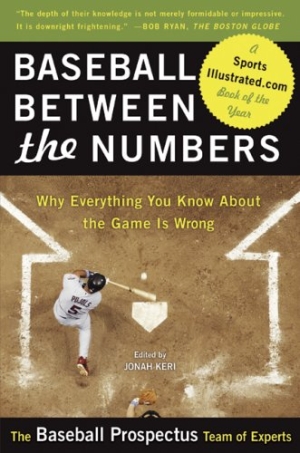
Baseball Between the Numbers: Why Everything You Know About the Game is Wrong

This book from Baseball Prospectus is for anyone who wants to look the baseball with a more critical eye. Most of the stats that populate the book are not very popular in the sabersphere nowadays, but the research and reasoning behind each chapter are still as relevant as ever. There’s the idea of a replacement player and how that is important to assessing a player’s true value, a method of comparing the competitiveness of different leagues (including the minors), a takedown of the perceived importance of the RBI, and plenty of other essential knowledge for any intelligent baseball fan.

There’s also a comparison of Barry Bonds and Babe Ruth and a look at how overpaid Alex Rodriguez is. There’s an argument for a return to the four-man rotation, something I’d love to see make a comeback. There’s a dismantling of the notion that managers actually make a significant difference. There’s even a section which slights how much Rickey Henderson’s stolen-base prowess increased his value as a player. Too much good stuff to lay out in this blog post.

My favorite chapter title has to be “Why Doesn’t Billy Beane’s Shit Work in the Playoffs?”, and it’s definitely one of the more enlightening chapters as well. It shows how the prevailing idea that pitching wins championships is actually somewhat true, that a great rotation has a positive correlation with success in the playoffs. For an example, look at how the Giants won the World Series this year. I guess this is where people who hate “Moneyball” would start reading the book.

Baseball Between the Numbers is just a perfect combination of good writing and good analysis. It doesn’t get too heavy with the stats, providing easy-to-understand charts when needed, and focusing more on the seemingly obvious conclusions which are arrived at after looking at the data, rather than the methodology. Yet everything is still explained enough so you know they are not just making things up nor manipulating the data to fit their agenda. It’s probably my favorite book out of the three which comprise this post.

The Book: Playing the Percentages in Baseball

This is the graduate course in sabermetrics. Do not read this book unless you like — or at the very least, understand — math. There are win expectancy matrices that take up multiple pages. All you have to do is look at Tom Tango’s website for The Book to realize that this is just pure analysis with little regard for enjoyable writing. The Book has, in addition to the usual Table of Contents, a list of the 140 tables in the textbook. That’s what The Book is — a textbook for managing a baseball game. The preface even says this is an attempt to rewrite “the [unwritten] book”.

The Book delves into platooning, the use of starters and relievers, pinch-hitting, sacrifice bunting, stealing bases, the intentional walk, lineup construction, and pretty much anything else that can be quantified. The authors use empirical data from multiple major league seasons to create their probability matrices and averages. If a math-averse person wanted to, they could just read the little boxes at the end of each section to see what “The Book” says on a specific topic without reading the details. An example would be:

Your three best hitters should bat somewhere in the #1, #2, and #4 slots. Your fourth- and fifth-best hitters should occupy the #3 and #5 slots. The #1 and #2 slots will have players with more walks than those in the #4 and #5 slots. From slot #6 through #9 put players in descending order of quality.

This flies in the face of the accepted wisdom of batting your best “overall” hitter 3rd, a fact which was gospel to me growing up.

As I said earlier, the stats mentioned in Baseball Between the Numbers aren’t exactly the darlings of the sabermetrics fan revolution nowadays. While the second book in this list talks about VORP (Value Over Replacement Player) and WARP (Wins Above Replacement Player), The Book uses WAR (Wins Above Replacement). The Book also goes into the creation and derivation of wOBA (weighted On-Base Average), which is an attempt to quantify each contribution from a hitter as accurately as possible. A stat like OPS (On-base Plus Slugging) weighs OBP (On-Base Percentage) and SLG (Slugging) equally, when OBP is about twice as important.

You must be getting the sense that this book is filled with acronyms and numbers and math. Not that Baseball Between the Numbers doesn’t have its hilarious acronyms, but it’s just not as heavy on the mathematical analysis. Or perhaps I just ignored many of the acronyms in Baseball Between the Numbers since no one uses them, even though the ideas behind them are sound.

The Book also explains the idea of WPA (Win Probability Added), which is tied to the probability matrices I mentioned earlier. Basically, this book is what spawned Fangraphs, which is why this is the book that has the popular acronyms. Baseball Prospectus is just not the sabermetric darling of the moment. While their analysis is better than Fangraphs’, most of it is behind a paywall which even I’ve never paid for (but I’ve been thinking about it lately).

So that’s what a degree in sabermetrics looks like. And once you take it, you won’t be able to stay away from websites like Beyond the Box Score, Fangraphs, Baseball-Reference (well, EVERY baseball fan knows this site), and The Book Blog. In addition to reading The Hardball Times website, you’ll order their Annual each year. Maybe you’ll even love the saber-tinted fantasy analysis at Roto Hardball.

“Sunshine (Adagio in D Minor)” is the New “Lux Aeterna (Winter)”

2010 November 29
by CajoleJuice

A couple of coincidences first:

- Obviously, both “Sunshine (Adagio in D Minor)” and “Lux Aeterna (Winter)” have parenthesis in their titles.

- The trailer for Sunshine used the Lord of the Rings: The Two Towers trailer remix of “Lux Aeterna” — which is the overused version.

Since I’m pretty sure I’ve never posted the song on here before, I might as well do it now:

It’s a terrific song, and one that fit the ultimate sacrifice which it scored in the film. It was a death that happened in possibly the most epic way possible — incineration by the sun. A very similar arrangement of the song was also used by John Murphy himself in Kick-Ass, albeit somewhat effectively during a slow-motion rescue scene. Tonight on The Walking Dead, it was used during an RV and station wagon road trip montage. Not exactly the same type of impact there.

The song was also used in a recent trailer that I needed to look up on Wikipedia to remember — The Adjustment Bureau. And apparently an arrangement was also used in the last scene of the season finale of V.  I guess the people behind the music for these trailers and TV shows have figured they’ve drained one well and it’s time to make everyone sick of another song. I just hope they never start using “Death is the Road to Awe“, which I prefer to both.

Your Daft Punk TRON Song of the Week

2010 November 26
by CajoleJuice

Daft Punk – C.L.U

The Tron: Legacy soundtrack doesn’t even come out for another two weeks or so, with the movie releasing a week and a half after that, but naturally it has already been leaked to the internet. I’d say listening to a soundtrack before seeing the movie might lessen the impact, but I’m not sure how much it’ll affect the vacuous laser show that Tron: Legacy will likely be. The Clint Mansell-orchestrated Black Swan soundtrack is a different story.

So this soundtrack is really, really good (keep in mind that YouTube quality is garbage). I picked this song because it’s probably the most epic track and while it doesn’t feature much of Daft Punk’s signature electronic sound, it throws a little in there. I could have also gone with “The Game Has Changed“, but that was used in one of the trailers already. And don’t worry if you don’t like Hans Zimmer, there are plenty of tracks with heavy synthesizer use, like “Derezzed“, along with more atmospheric songs like “Solar Sailer” and “Adagio for TRON“. But no one should be shocked that Daft Punk wanted to go a bit more traditional and classical when they got the chance to do the score for a major motion picture. If you obviously have the talent to utilize a 90-piece orchestra, why not do something you’ve never done before?

What I’m Thankful For

2010 November 25
by CajoleJuice

I figure this is as good a time as any to come up with a huge list of things again. It’s Thanksgiving, people.

I’m thankful for:

Seeing my hammered friend slowly walk up to a couple of high school girls with his arms held up in a muscle pose on Thanksgiving Eve.
My innate ability to be better than most of you at video games.
Receiving a NES when I was 3 years old — maybe that’s why I am an XBLA savant.
Daft Punk doing the TRON: Legacy soundtrack.
Dogs bringing a smile to my face every time I see one.
David Foster Wallace’s essay collections.
Chobani Greek Yogurt which I could eat all day to sustain me like Michael Westen on Burn Notice.
Baseball stats that allow me to prove people wrong when they spout garbage.
Having a working penis.
Growing up in a town with four seasons, near both near a coast and a world-class city.
Christopher Nolan putting out a blockbuster every couple of a years that I enjoy.
My bank account having money in it.
The wonder that is air travel, for at least one reason.
Netflix Instant Watch being an amazing service.
Rex Ryan and Mark Sanchez living up to the hype of Hard Knocks.
25 mph over the speed limit being the cruising speed on the Southern State Parkway.
The increasing prevalence of Wi-Fi hotspots.
Having a multitude of friends going all the way back to elementary school.
Alcohol making everything more entertaining.
Being a kid before dodgeball was banned from schools, allowing me to throw big balls in kids’ faces.
Never experiencing any serious health-related hardship.
David Wright, a player who has given the Mets 36 wins of value already in his career.
All the food I will be having this extended weekend, starting today.
Tyler Clippard winning 11 games last season, most of them for my roto fantasy team.
Having working plumbing and a toilet for reading magazines on.
Apple for HAHA just kidding.
Still having some semblance of sanity.

United 93

2010 November 24

Note: It’s funny how I wrote this post right as the TSA shit seems to be hitting the fan, but I won’t bother to comment on that here.

It took me far too long to watch this film. When it was first announced, I thought it was a disgusting exploitation of 9/11 or some similarly moronic teenage bullshit. I realize now how much of an idiot I was. I should have listened to not just the critics that lauded the film, but fellow internet denizens who absolutely loved it.

It is impossible for me to imagine a better film to chronicle the events of 9/11 than United 93. I haven’t seen World Trade Center and have no plans to, but Oliver Stone shouldn’t have even been allowed near the subject matter after this film already existed (a Twitter buddy pointed out that Stone shouldn’t be allowed near anything). Yeah, you could focus a story around the firefighters and policemen down at Ground Zero, but even United 93 sufficiently touched upon the feelings we had when we saw those terrifying images of the Twin Towers.

No matter what you might think of Paul Greengrass’ two Bourne films, the shaky-cam aesthetic works flawlessly here. Everything in the movie is happening in real-time, and Greengrass does a masterful job of putting you there right in the middle of the events.

Outside of some establishing scenes in the very beginning, the entire film takes place within air control centers, NORAD, and the eponymous flight. The film reminded me a bit of Apollo 13 in that sense, only the latter is typical Ron Howard melodramatic sap (still a good movie), while United 93 is far more restrained, yet still devastatingly affecting.

I’m not the first person to have this thought: “If United 93 was Schindler’s List, then World Trade Center would be Apollo 13.” That analogy might be a bit off, but I think you get it. Really, wouldn’t Saving Private Ryan in Apollo 13‘s spot make more sense in that analogy? But like me, the reviewer no doubt wanted to namedrop Apollo 13.

Which brings me to another (perhaps unfair) point: United 93 consists of mostly unknown actors. I recognized one, maybe two, people in the entire film. It’s not like Tom Hanks is the hero on the flight that rallies other passengers to storm the cockpit; nor is Nicholas Cage running around the rubble of the World Trade Center with a ridiculous mustache. The low-budget nature of the film allows it to feel more authentic by not pulling you out of the moment with an actor you’ve seen flying fighter jets or playing a international secret agent before. You feel as if these truly could have been the people on the flight, or the ones trying to make sense of the madness down on the ground.

It is through these people on the ground, in the control rooms, that Greengrass allows the viewer to re-experience the attacks of 9/11. It seems a bit strange that the National Air Traffic Control Center or NORAD wouldn’t realize what happened before they turn on CNN, but the film does allege to recreate the events as accurately as possible, and it’s those all-too-familiar television images that immediately evoke the feelings of that day. The controllers first seem nonplussed at the idea of a hijacked plane and then stand in disbelief and confusion once footage of the first attack comes up on the big screen. I immediately thought of my 10th grade history class, where another teacher came in the class and said something about a plane hitting the top of the Twin Towers; no one thought much of it, thinking it had to be some sort of freak accident with a small plane.

It wasn’t until another plane was hijacked that some sense of the exception situation sunk in, and I have to imagine everyone involved knew what was happening once that second plane took its course at downtown Manhattan. Nine years later, I still felt a twinge of dread watching it fly towards its final destination in the middle of the World Trade Center’s South Tower. It was something I didn’t see live. In fact, I didn’t know anything past the initial accident until I walked into my English class and my bit-of-a-hardass, middle-aged female teacher was visibly upset. I remember her trying her best not to cry — but failing miserably — while informing us the Twin Towers were gone. Totally gone.

But what I didn’t know at the point, and not until I got home at the very earliest, was that one flight had been stopped from reaching its intended target. It was a small victory on a tragic day, and United 93 chronicles it soberly and beautifully. The people on that flight didn’t want to die, but they knew — from being relayed information about the attacks through loved ones — that they were on a suicide missile. While most of the events on the plane probably had to be imagined, and it was a bit comical to have the one appeaser on the flight not be American (and unfair to the memory of the man who the character is based on), there’s nothing that stands out as unbelievable.

I don’t think any of the people on the flight would have characterized their actions as especially brave; they undoubtedly saw storming the cockpit as their only course of action, much like the New York City firemen who sacrificed their lives in the Twin Towers. But they were brave, and in their final moments, these regular people became heroes that deserved to be remembered as they are portrayed in this film.